Nature-Based Solutions
Nature-Based Solutions (NBS) refer to strategies that utilize natural processes and ecosystems to manage water resources, reduce flood risks, improve water quality, and enhance overall hydrological resilience. They fall in the context of blue-green infrastructure, water-sensitive urban design, and sponge cities.
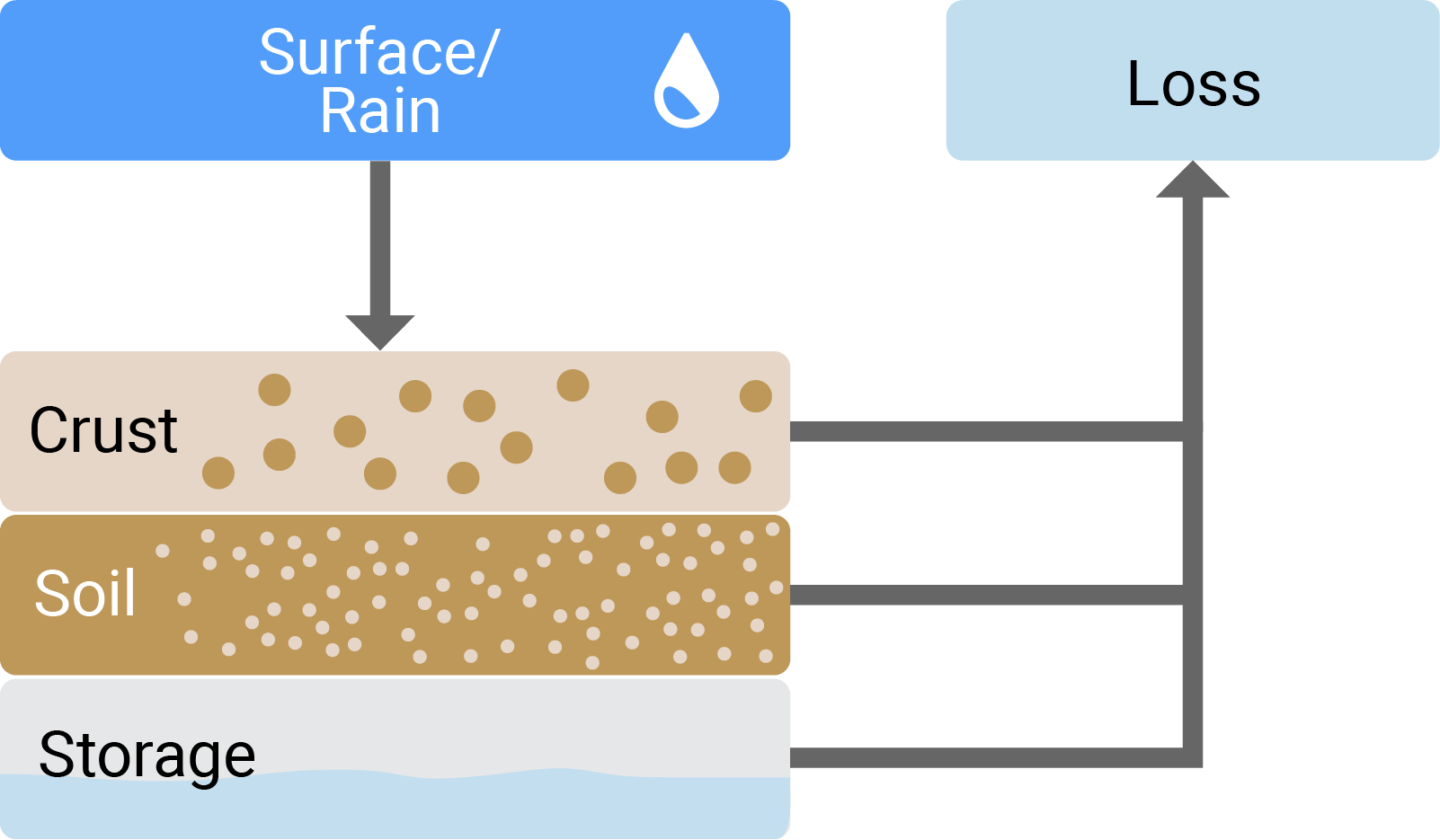
In scenarify, nature-based solutions are modeled with a multi-layer system featuring a crust layer, a soil layer, and an underlying storage layer.
Additionally, a constant loss rate can be set to model for example evapotranspiration.
Typically, nature-based solutions like rain gardens and bioretention swales are affected by both rain and overland flow. In contrast, green roofs are solely affected by rain and do not interact with overland flow.
Two-Layer Infiltration with Storage
The two-layer Green–Ampt model is used to calculate infiltration, based on seven parameters.
As in the single-layer model three parameters are used to characterize each layer. The parameters for the crust are denoted by the subscript \(c\), while the soil parameters are denoted by the subscript \(s\). The crust thickness \(Z_c\) marks the transition between the crust and soil. When the soil thickness \(Z_s\) is finite, the storage depth \(S\) sets the storage capacity.
In the two-layered Green–Ampt model, the infiltration rate \(f\) is calculated by adapting the parameters of the single-layer model based on the wetting front depth \(D\). As the wetting front changes, the model updates the parameters to reflect the different soil layers. The effective saturated hydraulic conductivity \(K_e\) is defined as
The effective suction head \(\psi_e\) is defined as
And the effective difference porosity \(\Delta\theta_e\) is defined as
When the wetting front depth \(D\) reaches \(Z_c + Z_s\), it can no longer advance, and any additional surface water that infiltrates into the soil will start filling the storage layer. Once the storage is full, no further infiltration is possible.
Loss
The loss rate represents constant water loss, such as evapotranspiration. The loss is taken from the storage if it contains water; otherwise, it is drawn from the wetting front depth. In both cases, the loss is limited by the available water in the storage or the wetting front.