Rivers and Streams
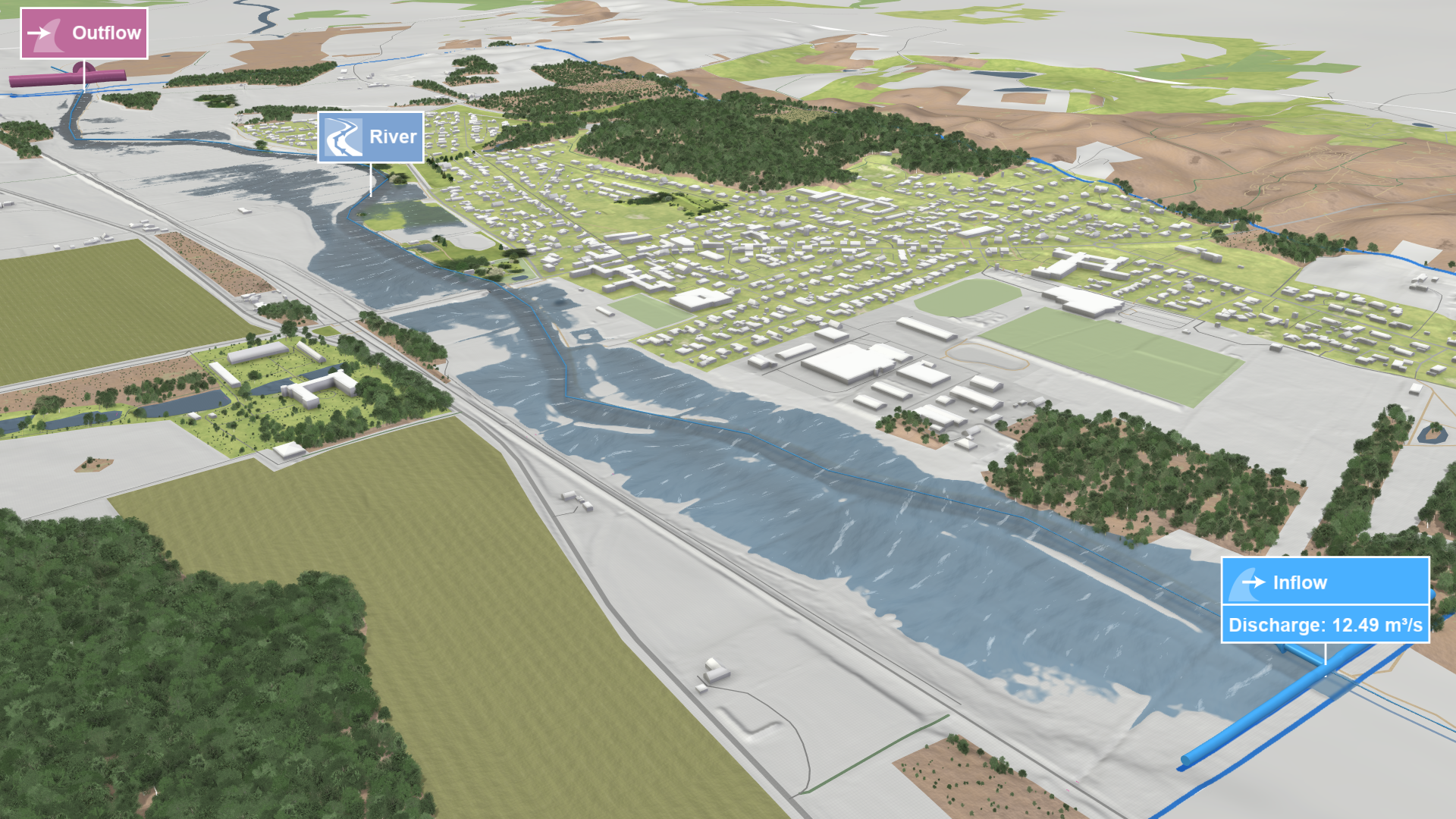
Inflows and outflows are are used to set up river flood simulations. Typically, historical or predicted river discharges are used for inflows, while water levels or rating curves are used for outflows. The additional provision of geometric information on the river, including its length, width, depth, and slope, is useful. Numerically, inflows and outflows are specified as inflow and outflow boundary conditions along cell interfaces.
Hint: For a workflow on riverine flood scenarios, please refer to River Modeling.
Inflows
Inflows refer to the river cross-section where water enters the simulation domain. They are defined with Inflow actions. For inflows, discharge time series are used to control the volumetric influx. They can be complemented with water level time series to guide the water distribution along the inflow river cross-section. Properly defining inflow discharges is essential for predicting river behavior. Inflows with dicharges determined from extreme value statistics should be used for hazard analysis. scenarify allows users to:
- Define multiple inflows within a single simulation domain.
- Input data from historical records, extreme value statistics or predictive models.
- Adjust inflow parameters to simulate different scenarios.
Outflows
Outflows refer to the river cross-section where water exits the simulation domain. They are defined with Outflow actions. scenarify allows users to define multiple outflows within a single simulation domain. For outflows, water level time series or rating curves are used to control the water level at the outflow.
If the Automatic mode is selected for an Outflow, the system applies the specified rating curve to dynamically provide water level boundary conditions. A rating curve defines the relationship between stage (water level) and discharge. At each outflow, the water discharge exiting the simulation domain at the outflow cell interfaces is converted to the corresponding water level using the specified rating curve. This water level then serves as a boundary condition driving the simulation. The rating curve is also used to estimate the initial and peak water level for the outflow from the discharges of a linked inflow.
If the rating curve for the outflow cross-section is calculated using the Manning-Strickler formula, the cross-section is divided into segments with approximately uniform roughness. The mean velocity \( v \) for each segment is then computed using the following formula:
where \( n \) represents the Manning's roughness coefficient, \( R \) is the hydraulic radius, and \( S \) denotes the energy slope.
Lateral Inflows
Lateral inflows represent smaller tributaries or diffuse runoff sources that are not explicitly modeled as river inflows but still contribute additional discharge to the main river. Their effect can be included using Lateral Inflow actions, which define polygonal zones where water is added based on a discharge time series. These inflows are applied as a source term in the shallow water equations (SWE) to distribute the added discharge to the wet cells within each polygon.
Streamflow Adjustments for Consistent Return Periods
In river flood hazard mapping, lateral inflows can also be used to maintain consistent return periods (e.g., a 100-year flood) across the entire river network. The adjustments provided by lateral inflows ensure that peak discharges correspond to the same return period throughout the system. This is achieved by adding or removing water to balance differences in the hydrological flood waves between upstream and downstream sections. This approach is particularly recommended for small tributaries to ensure a consistent return period along the main river.
Automatic lateral inflows are positioned at the river nodes of the network when the base model includes a river node network with defined flood discharges. Along river sections where smaller tributaries or diffuse inflows are not explicitly represented, additional discharge is applied along the main channel at the automatic lateral inflows to account for their contributions. The adjustment is calculated as the difference between the sum of the upstream flood waves and the downstream flood wave. This difference is typically positive around the peak flow period, indicating that water is added to the hydraulic simulation to maintain consistent return periods across the domain.
At river confluences, the combined peak discharge of a tributary and the upstream section of the main river is often greater than the downstream peak discharge, since large floods in both streams rarely occur simultaneously. To correct for this, the adjustment at each confluence is again determined by the difference between the sum of the upstream flood waves and the downstream flood wave. In this case, the difference is usually negative around the peak flow period, indicating that water is removed from the hydraulic simulation at confluences to maintain consistent return periods. This approach keeps the peak flow aligned with hydrological expectations, ensuring both mass balance and the desired return period across the network.
This method was applied in Buttinger et al. 2022 to compute nationwide river flood risk maps for Austria.
References
Buttinger-Kreuzhuber, A., Waser, J., Cornel, D., Horváth, Z., Konev, A., Wimmer, M. H., Komma, J., and Blöschl, G., 2022. Locally relevant high-resolution hydrodynamic modeling of river floods at the regional scale. Water Resources Research, 58, e2021WR030820.
Publication available online: 10.1029/2021WR030820