Roughness
Determining roughness is a critical component in hydraulic simulations, influencing how water flows over surfaces. scenarify supports spatially varying roughness, enabling different roughness values across the simulation domain to reflect heterogeneous surfaces accurately. The roughness is usually quantified using empirical coefficients that reflect the surface texture and vegetation. In scenarify, roughness coefficients can be assigned either from raster data or predefined values based on land use.
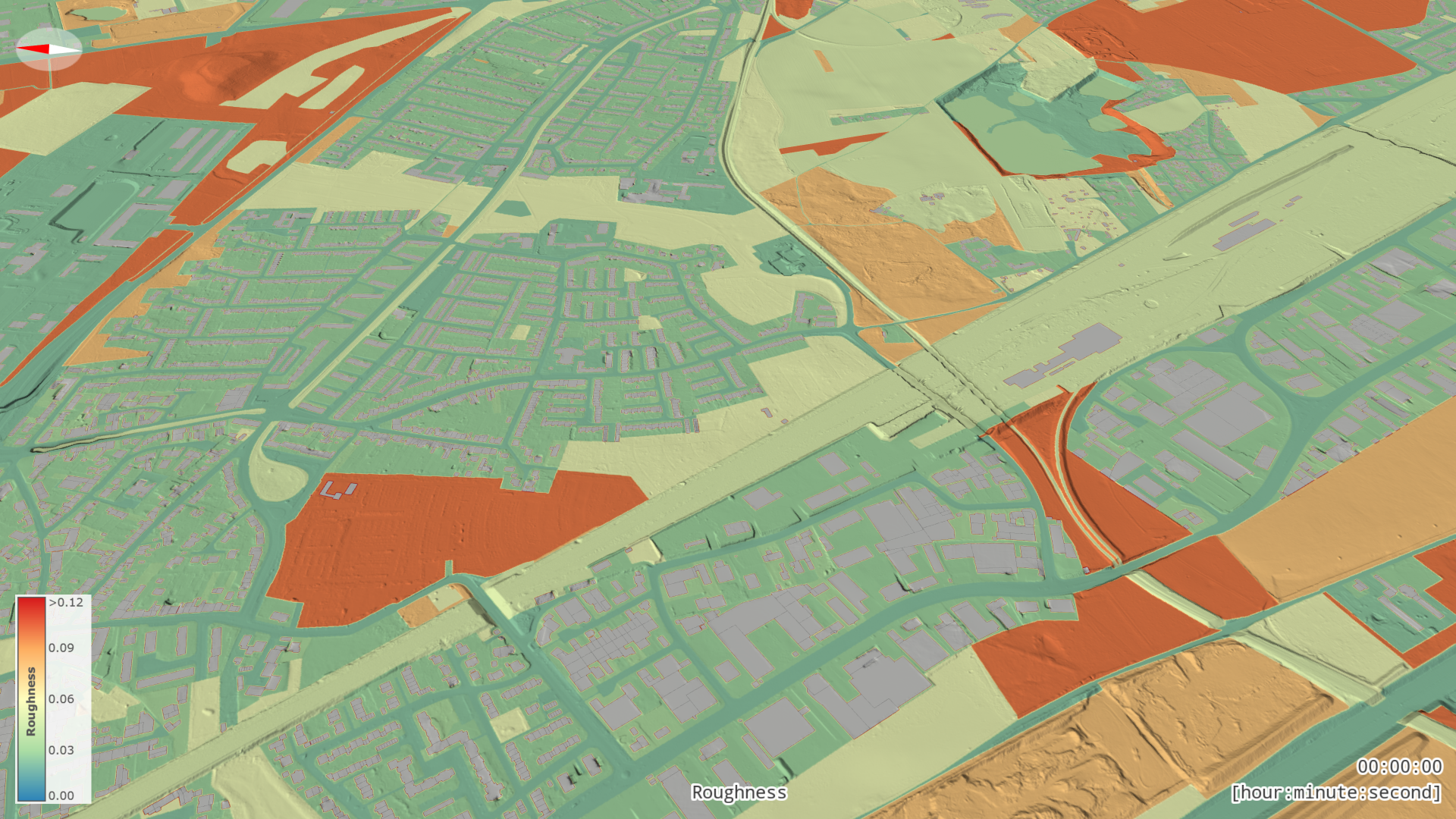
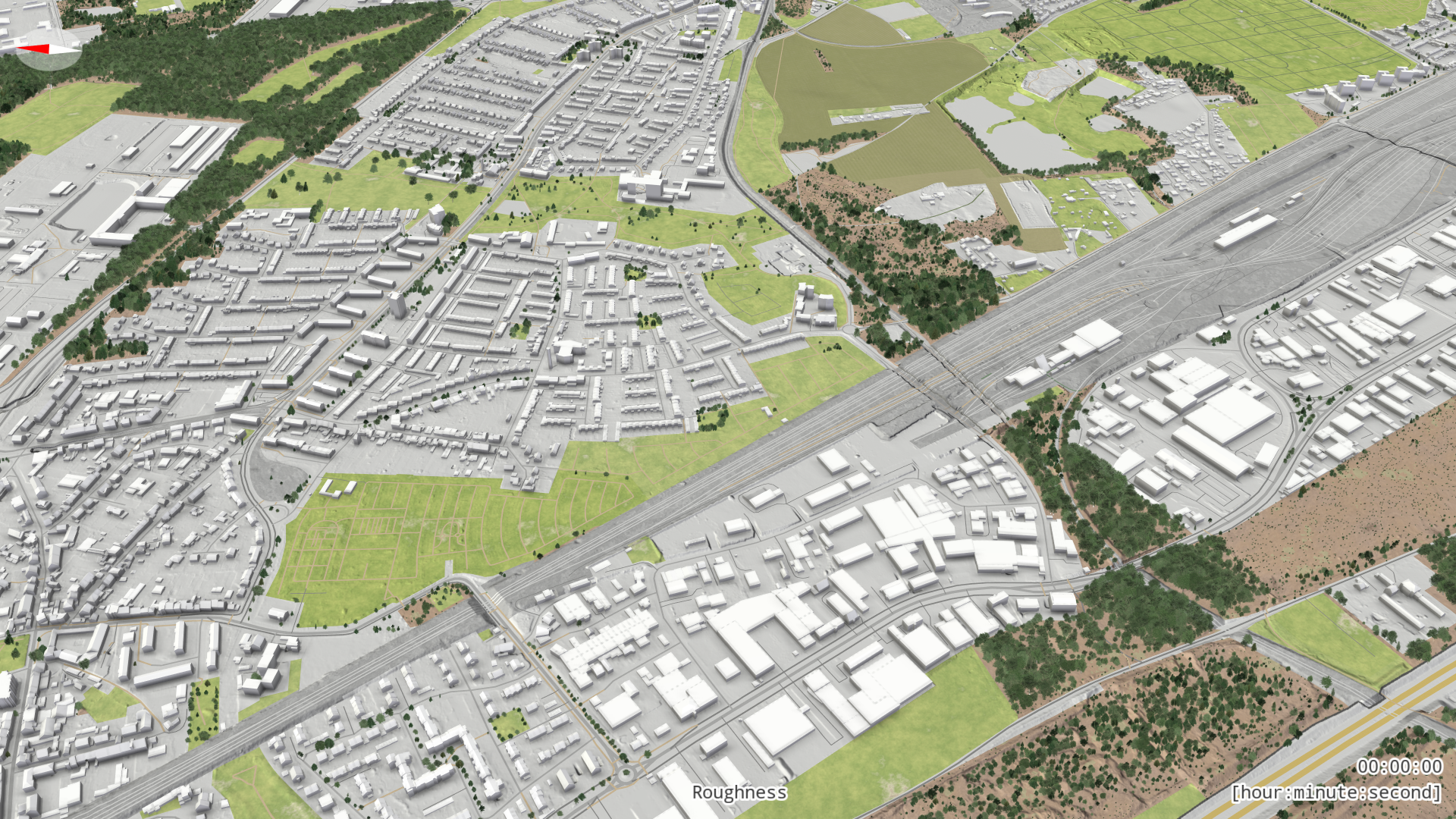
Roughness coefficients can also be locally adjusted using the Roughness Zone action.
The friction term \(\mathbf{S}_f\) is evaluated semi-implicitly in the surface water model. The roughness coefficients can be specified as Gauckler-Manning coefficients \(n\) with a unit of \(s/m^{1/3}\) or as Strickler coefficients \(k_{St}\) with a unit of \(m^{1/3}/s\). They are related via \(n=1/k_{St}\). scenarify also supports uniform and non-uniform water-depth dependent thin film roughness.
Calibration against observed data ensures that the chosen roughness values provide realistic results, see the use case tutorial Comparison and Calibration with Measurements.
Uniform Water-Depth Dependent and Non-Uniform Thin Film Roughness
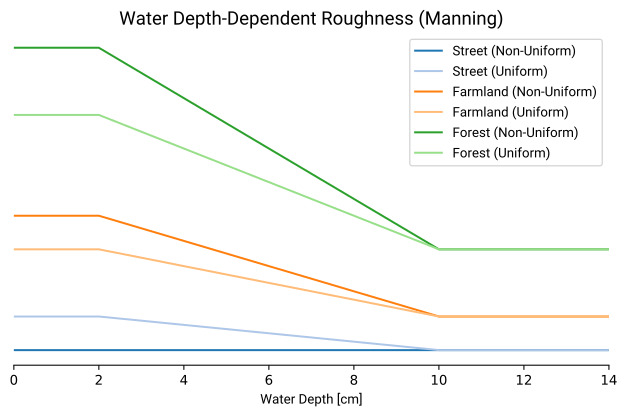
In hydraulic simulations, surface roughness decreases as water depth increases. When the water depth is very small, surface irregularities significantly impact flow resistance, thus enabling water-depth dependent roughness is crucial for simulating very shallow water flow. In scenarify, thin-film roughness can either be applied uniformly by scaling the roughness value or by providing non-uniform thin-film roughness for specific zones. Thus, below the specified lower value of the water depth scaling interval, either the uniformly scaled value of the original input roughness or the provided thin-film roughness value for the specified land use type is used. Above the upper value of the water depth scaling interval the original input roughness is used. For water depths inside the scaling interval, the scaling is applied gradually.
Here is an illustration of how the water-depth dependent roughness works for a water depth scaling interval from 2 to 10 cm. The non-uniform thin-film roughness values are given in the table below as Manning's roughness coefficients. For the uniform water-depth dependent roughness a scaling factor of 2 is used. Non-uniform thin film roughness allows the use of constant roughness for streets while for forests the factor is even greater than 2.
| Land Use | Roughness | Thin-Film Roughness (Non-Uniform) | Water-Depth Dependent Roughness (Uniform) |
|---|---|---|---|
| Street | 0.02 | 0.02 | 0.04 |
| Farmland | 0.04 | 0.1 | 0.08 |
| Forest | 0.08 | 0.2 | 0.16 |
Roughness in Urban Areas
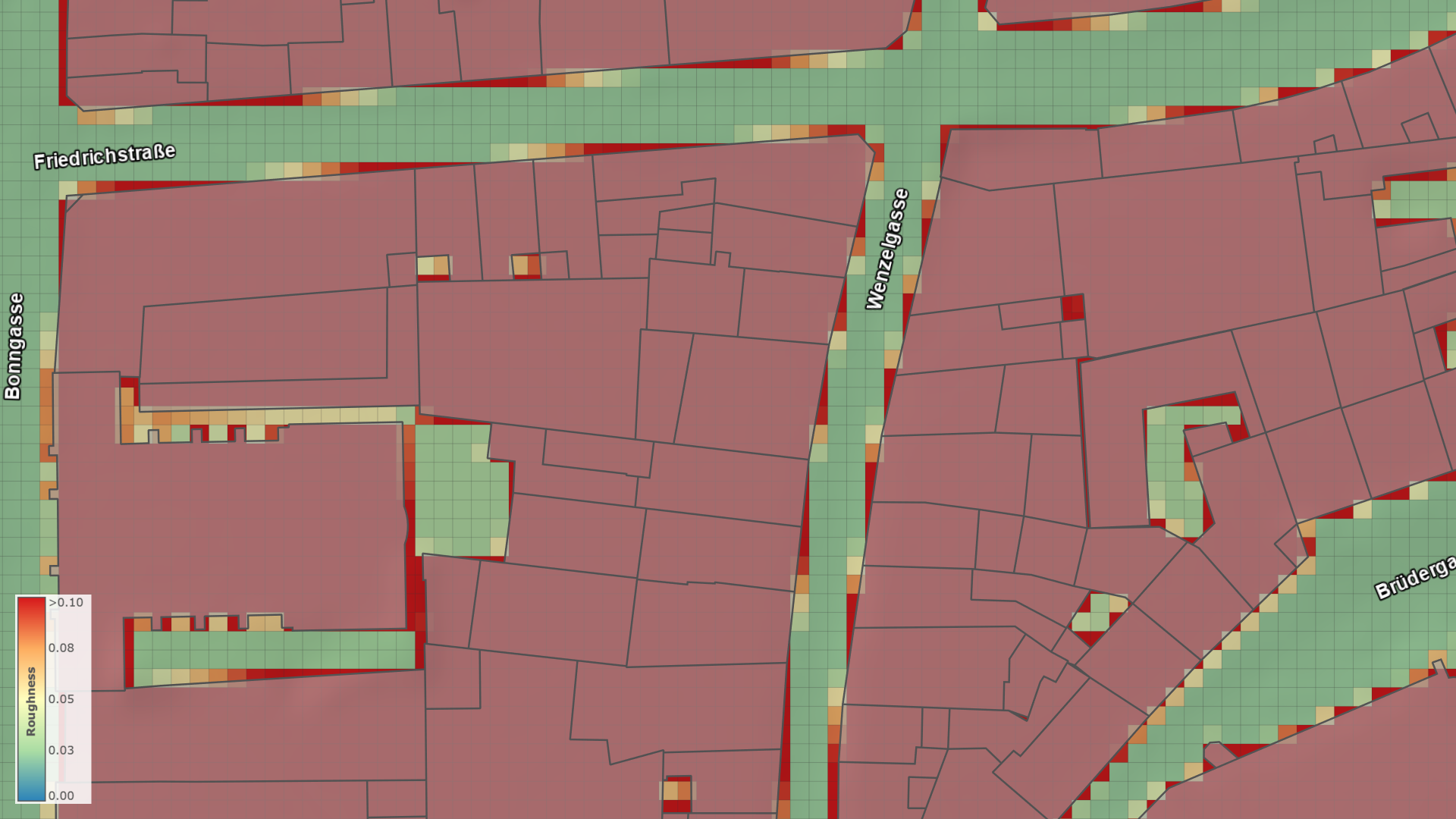
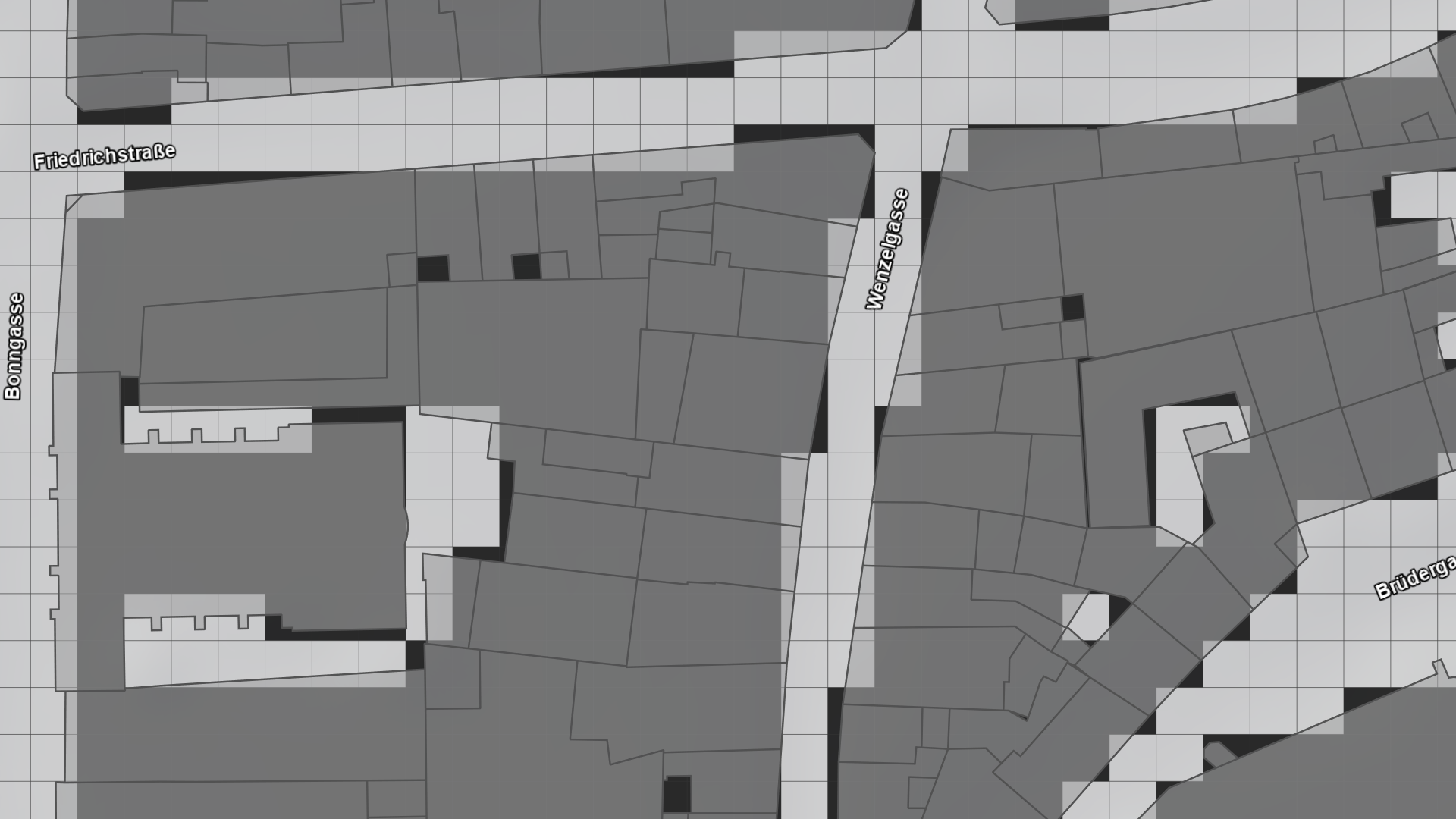
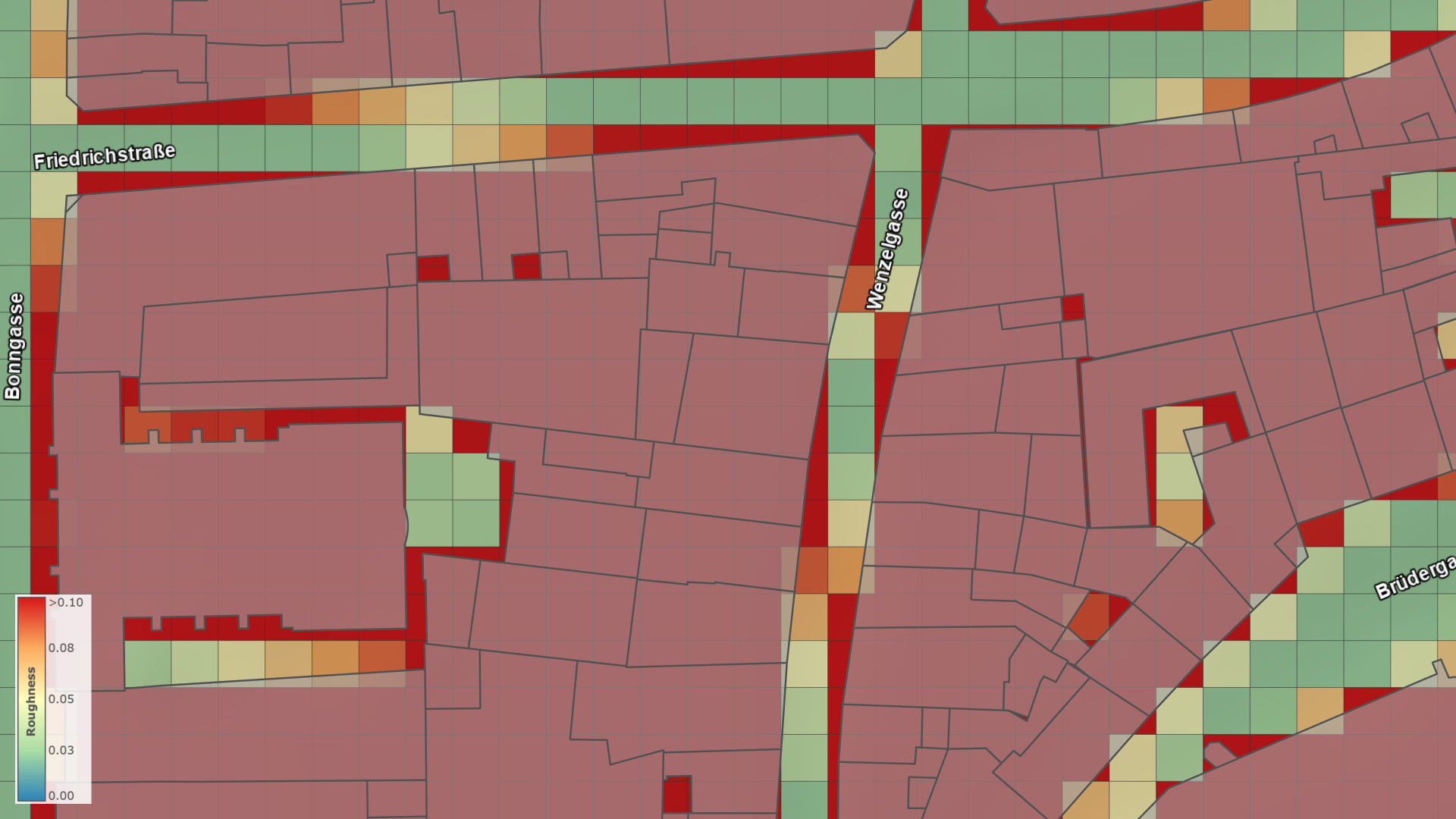
For simulations in urban areas, flow near buildings may be reduced as significant portions of the cell are blocked by buildings. In the vicinity of buildings, the roughness is increased up to 0.12 to account for the impermeable fraction of the cell. If more than 60 % of the cell is covered by buildings, the cell is modeled as an impermeable wall. This effect is most pronounced in narrow streets. The screenshots below illustrate how buildings influence the roughness values and flows of narrow streets.
The cells shown in black are modeled as impermeable wall.
For cells that are partially or fully covered by buildings, the roughness values are increased accordingly.
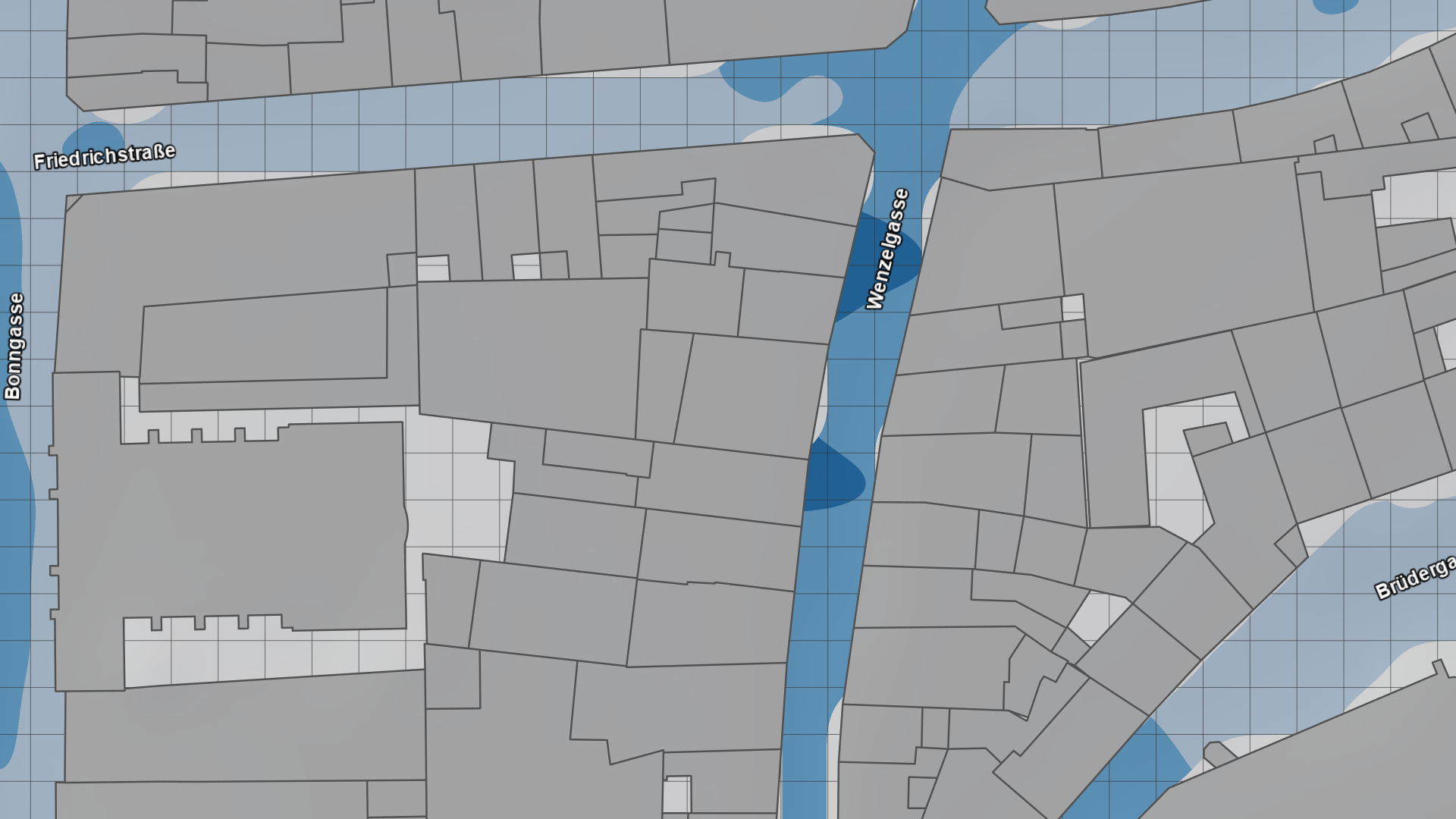
When a finer simulation grid resolution is used, cells with increased roughness are concentrated mainly along the street edges.