Culverts
Culverts are hydraulic structures that allow water to flow beneath the surface, e.g. under a road, railroad, building. They can be loaded from a shape file and interactively edited or added via the Culvert and Bridge action.
In scenarify, Culverts are modelled as a one-dimensional (1D) structure consisting of two sides, an inlet and an outlet. No bifurcations of culverts are allowed. Culverts themselves cannot hold water. In fact, the water flowing through a culvert is immediately transferred from the inlet to the outlet. The discharge through the culvert is controlled by the cross-section geometries and the water levels at the inlet and outlet.
Discharge Computation
In general, the discharge \( Q \) is computed with the following formula:
where:
- \( c \) is a discharge coefficient that accounts for flow resistance and depends on culvert characteristics, e.g., material and geometry and flow control,
- \( A \) is the culvert area at the relevant cross-section,
- \( g \) is the gravitational constant, and
- \( \Delta w \) is the difference in water level, to be specified in more detail.
Depending on the different flow conditions at the inlet and outlet, we distinguish four possible states in which water may flow, namely Case A, B, C and D. If both inlet and outlet are dry, or the water levels are below the maximum invert levels, no flow occurs. This case is denoted as Case 0.
An overview over these cases is given by the following table.
| Inlet is \ Hydraulic jump occurs | Yes | No |
|---|---|---|
| Partially submerged | Case A | Case B |
| Fully submerged | Case C | Case D |
Case A
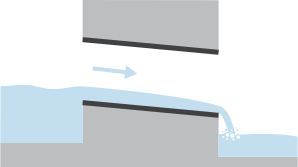
The inlet is not fully submerged and the culvert cross-section is not completely filled with water. A hydraulic jump occurs and thus there are no backwater effects at the inlet.
The discharge \( Q \) is given by:
where
- \( A_{critical} \) is the cross-section area at critical water depth, and
- \( h_{critical} \) is the critical water depth.
This case happens, for example, if the culvert inlet is wet and the outlet water level is below the outlet invert.
Case B
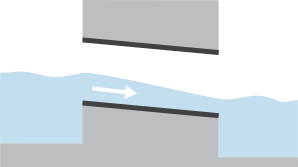
The inlet is not fully submerged and the culvert cross-section is not completely filled with water. No hydraulic jump occurs and there are possible backwater effects from outlet to inlet.
The discharge \( Q \) is given by:
where
- \( c_{B} = \sqrt{1 - \left(\frac{h_{out}}{h_{in}}\right)^{16}} \) is a choking coefficient based on \( h_{out} \), the water depth at the outlet, and \( h_{in} \), the water depth at the inlet. Both water depths are measured from the same invert elevation at the outlet cross-section.
- \( A_{critical} \) is the cross-section area at critical water depth, and
- \( h_{critical} \) is the critical water depth.
Case C
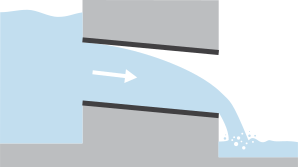
The inlet is fully submerged and the cross-section at the culvert inlet is completely filled with water. A hydraulic jump occurs and thus there are no backwater effects at the inlet.
The discharge \( Q \) is given by:
where
- \( A \) is the culvert area of the inlet at full section,
- \( w_{in} \) is the water level at the inlet, and
- \( z_{mi} \) is the maximum invert level of the culvert cross-sections.
Case D
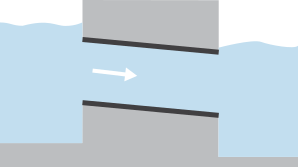
The inlet is fully submerged and the cross-section at the culvert inlet is completely filled with water. No hydraulic jump occurs and there are backwater effects at the inlet, resulting in water piling up at the inlet.
The discharge \( Q \) is given by:
where
- \( A \) is the culvert area of the inlet at full section,
- \( w_{in} \) and \( w_{out} \) are the water levels at the inlet and outlet, respectively.
Case D includes the situation, where both inlet and outlet are fully submerged.
Remarks
- The inlet and outlet sides of a culvert may change over time, as water may flow first in one direction and later in the other direction.
- The discharges are distributed onto all affected cells at the inlet and outlet, using the same approach as recommended in Fernandez-Pato et al. (2020). Water levels used for culvert discharge computation are the respective maxima of the affected cells at the inlet and outlet.
- The cross-section areas are approximated from the minimum water level, the invert elevation, up to the maximum water level with a total of 100 samples and linearly interpolated in-between.
- In the current version, the velocities of the surface water at the inlet and outlet are neglected for the culvert discharge computation.
- Culverts preserve a lake-at-rest steady state, meaning that if the water level is the same at both inlet and outlet, no flow is generated.
- If flow over the obstruction, e.g. a road, occurs, it is handled by the 2D overland flow simulation. Any occurring hydraulic jumps on the surface are handled implicitly by the shallow water solver.
- Culverts are excluded from simulation, if the inlet or outlet cross-section is completely beneath the terrain.
Culverts vs. Sewer Network Simulation
Here are some considerations on when to model culverts as a sewer network:
- Culverts that are longer than 50 m should be modeled with the coupled sewer network simulation to account for the pipe slope and the time delay of the water transfer from one side to the other.
- The sewer network also allows for bifurcations, which are not allowed in culverts.
Culverts vs. Burn-Ins
In hydraulic modeling, the choice between modeling culverts with the above approach and modeling them via structure removals actions, that is burning the culverts into the digital elevation model (DEM), depends on the specific context and objectives.
Model a culvert as a culvert:
- If the culvert is narrow, e.g. if it has a diameter not greater than 1 m.
- If the culvert lies benath a building or any other larger obstacle, because then the building is kept in the 2D surface flow simulation.
- If you know the exact geometries of the inlet and the outlet, as the cross-sectional areas will be represented exactly.
- If you are unsure.
Model a culvert as a burn-in:
- If the culvert represents a wide underpass where the bridge deck is not relevant. Burning culverts directly into the DEM ensures a full 2D instationary simulation of the structure and no reduction to a 1D formula. However, this comes at the cost of losing the retaining effect of the bridge deck if the culvert or underpass is fully submerged in case of high water levels.
References
- Fernández-Pato, J., Martínez-Aranda, S., Morales-Hernández, M., and García-Navarro, P. 2020. Analysis of the performance of different culvert boundary conditions in 2D shallow flow models. Journal of Hydroinformatics, 22 (5): 1093–1121.
DOI: 10.2166/hydro.2020.025 - Bollrich, G. 2019. Technische Hydromechanik 1: Grundlagen. Beuth Verlag GmbH.
- Patt, H., and Jüpner, R. 2013. Hochwasser-Handbuch. Berlin, Heidelberg: Springer Berlin Heidelberg.