Wall Boundaries
There are two main sources for wall boundaries within the simulation domain, buildings and barriers.
Buildings
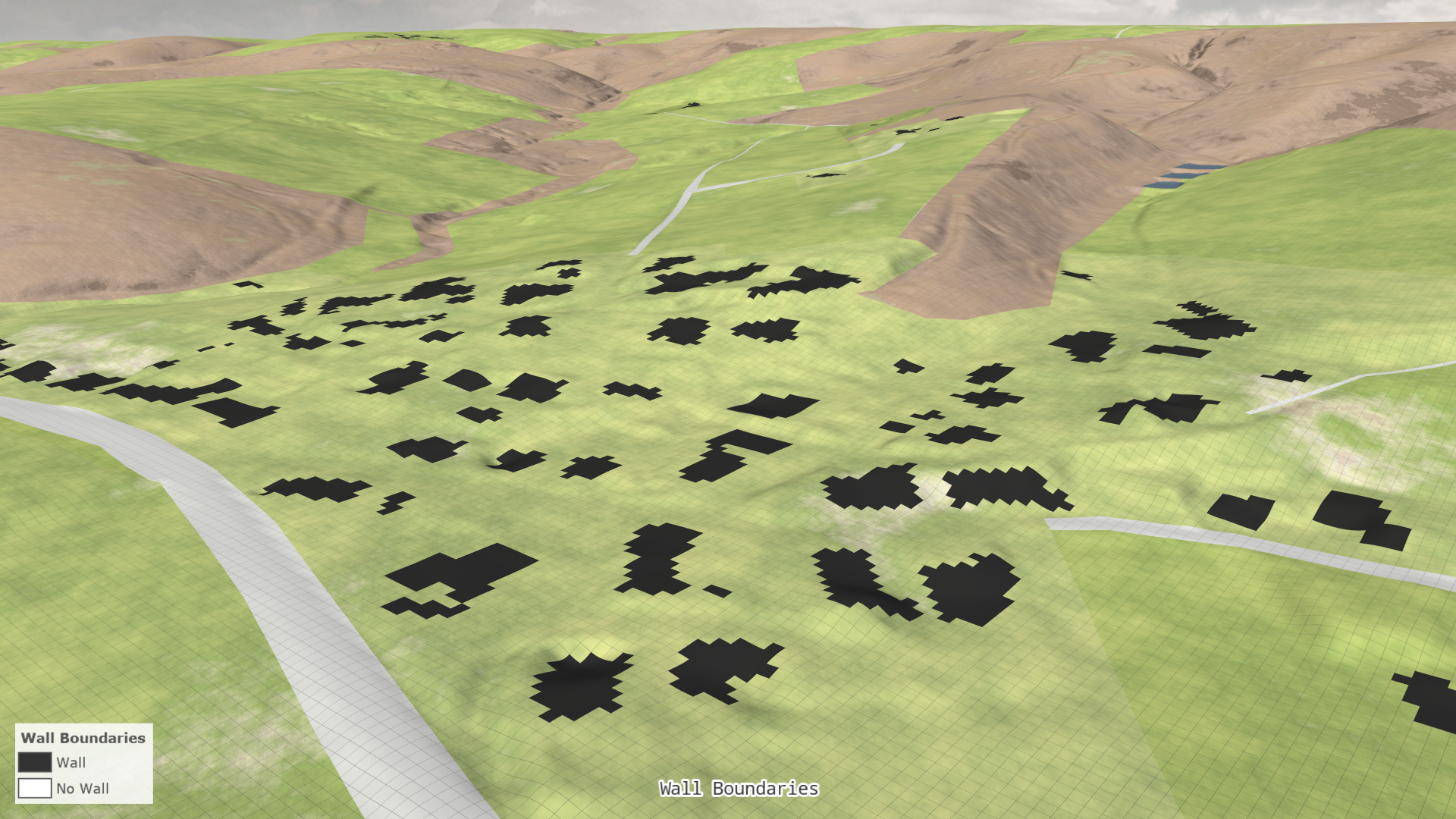
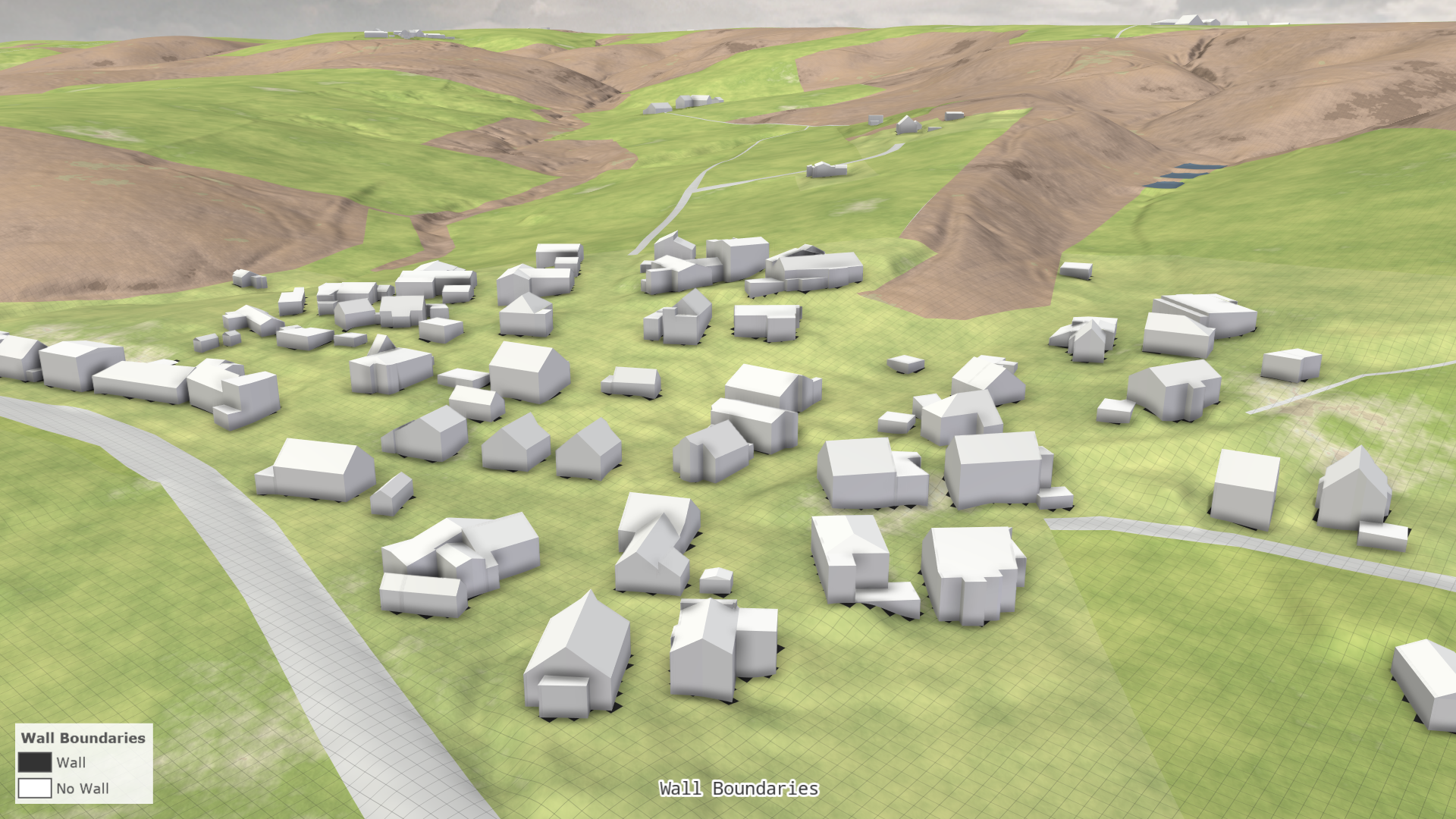
A proper representation of the impermeable walls of buildings is crucial when simulating urban scenarios. The footprint polygons of buildings are rasterized on the given simulation domain and flagged as wall boundaries. If more than 60 % of the cell is covered by buildings, the cell is modelled as impermeable. At the cell interface between valid cells and wall cells so-called Wall Boundary Conditions (BCs) are specified. They do not allow any flow through these cell interfaces. If the wall boundary condition should be disabled for a specific building, use the Disable Building Wall Boundaries action.
Gateways and Inflows
Gateways, such as entrances to garages or courtyards, are critical for enabling inflows through a building into courtyards and other enclosed spaces. Accurately modeling these gateways allows for realistic simulation of fluid dynamics as they enter and interact with the building's interior spaces. Gateways can be loaded from a polygons shape file or set up interactively with the Gateway action.
Barriers
Various barrier types are supported in scenarify, ranging from Aqua Barriers, Big Bags, Concrete Walls, Mobile Walls, to Sandbags. For some barriers, e.g. Concrete Walls there exist several modes to assign a spatially varying line elevation to these barriers. These barriers are then modelled as overtoppable walls. For others, e.g. the Concrete Wall (auto), the simulation considers it as not overtoppable and it will compute the necessary elevation from the adjacent maximum water levels.
Overtoppable Walls
Barriers with an assigned elevation can be overtopped by water in the flood simulation. If the adjacent water level exceeds the wall level, which is given by the local crown elevation, the water can flow over the barrier. The 2D simulation accurately represents the fluid dynamics over these barriers, distinguishing between subcritical and supercritical flow states, e.g. emerging hydraulic jumps. Internally, overtoppable walls are modelled as modifications to the bathymetry of the 2D surface water simulation, such that the bottom level corresponds to the wall level.
Thin Walls
In scenarify, barriers, such as walls, are represented as linear objects, which are on-the-fly resampled on the simulation grid. This allows accurate representation for any specified simulation domain. Still, the minimum width of barrier lines is given by the simulation domain cell size. See also the discussion on Why Not Use Triangular or Adaptive Grids to Support Small Structures?.
Breaches
In simulations, barriers such as dikes can experience breaches. These breaches can occur due to various factors, such as structural failure, external impacts, or natural disasters. In scenarify, a Breach can be drawn to simulate scenarios where dikes are compromised.